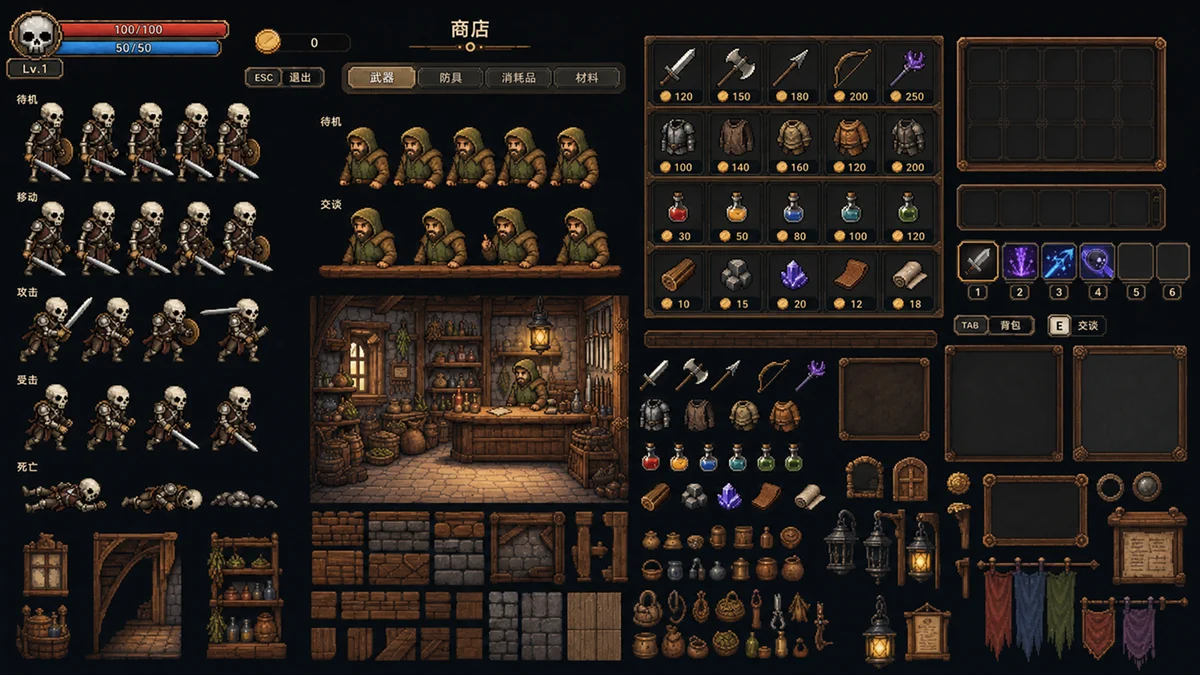
Using AI to generate sprite sheets and clean them up into game-ready pixel art
TL;DR
Turning AI-generated sprite sheets into game-ready pixel art often stalls on two problems: scene classification and semantic roles (Friction 1), and turning loose bitmaps into structured engine assets (Friction 2). For both, VberAI makes split, extract, and cleanup work more practical. The rest of this note covers remaining friction, Cursor-style Rules for context, and naming / metadata.
Reddit discussion
There is a related thread on Reddit r/aigamedev:
Using AI to generate sprite sheets and clean them up into game-ready pixel art
The thread follows one pipeline: generate sprite sheets with AI, then clean them into pixel art that can enter a game. Common failure modes in the comments include outputs that do not drop cleanly into an engine, unstable animation frames, and cleanup that still needs heavy hand work.
While documenting flows such as Smart Layering, those failure modes break down into more specific friction points.
Friction analysis
Friction 1: Sprites need classification and scene semantics
Once a sprite enters a game, it is usually assigned a role, for example:
- Scene architecture / decorative elements: relatively fixed position, little interaction, usually no collision setup
- Interactive / collidable objects: often carry collision, occlusion, layering, and sometimes state changes
Before an asset “looks like a sprite,” it already implies classification and expected behavior. Image models are stronger at generating pictures than at systematically answering what role a sprite plays in a scene. VberAI does not yet treat classification and scene semantics as a system feature either: split, extract, and organize are available, while “decoration vs collider” decisions still land mostly on batch work after export in an IDE.
Friction 2: Art assets should be structured data, but are often handled as loose images
Game art ends up in engine folders and reference graphs. A more stable form looks like a structured resource description—type, purpose, relationships, and searchable fields. Anonymous bitmap piles do not support automation well.
AI generation usually produces one image or a set of images first; structure is filled in later. VberAI Layer Split / region selection improves boundary control (see Smart Layering), but the structuring path is still labor-heavy: select, layer, confirm, repeated per image, with cost rising as asset count grows. The core question is whether the processing steps can become reusable structure, not only a one-off completion.
Friction 3: How common-sense context reaches the model—rules differ inside one UI frame
Elements in the same interface image need different generation constraints:
- Character portraits / avatars usually need a single result, not idle, run, attack, or other multi-frame states—yet unconstrained generation often emits extra multi-frame state sheets (title illustration)
- Multi-frame animation needs stronger consistency constraints (proportion, facing, timing, key frames), with higher regenerate-and-filter cost
- Elements that appear only partially in a UI frame: direct generation can sometimes complete cropped regions; manual split-then-extract alone is limited by missing local information in the source
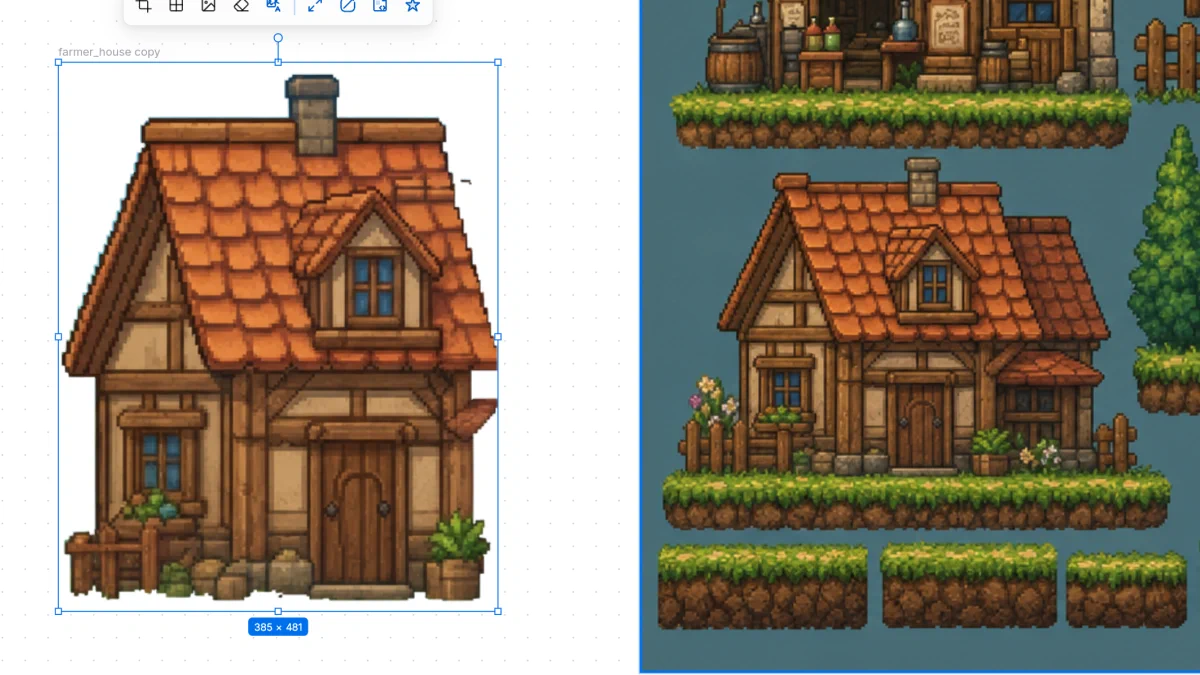
What is missing is something closer to Cursor Rules: reusable, switchable context constraints such as “single frame only,” “run cycle required,” or “allow completion of occluded regions,” then passed to the model. If common-sense constraints do not arrive reliably, results tend to stop between “visually acceptable” and “directly usable in-engine.”
From the same Reddit thread:
I tried doing this with nano banana. I was trying to animate a cartoony dinosaur running. It would create the sprite sheet, but I couldn’t get enough good frames to make a convincing run animation.
I ultimately just cut out the limbs and tried animating them as a 2d skeleton in Unity. Just like anything, I think it takes practice and creativity to make these things work.
That feedback maps to the same limit: a model can emit a sprite sheet without stably producing enough usable animation frames; the workflow falls back to more controllable part-splitting / 2D skeleton setups. The gap is not only image quality—it is whether task context and acceptance criteria enter the toolchain.
Friction 4: Automated naming and metadata—supporting MCP / IDE calls
Art assets eventually pack into an engine. For useful collaboration through MCP and IDEs such as Cursor, callability depends more on metadata behind the image than on the bitmap alone.
Effective orchestration usually needs two layers:
- Meaningful naming — establish initial context (what the object is, which class it belongs to, which step it serves)
- Richer built-in metadata — search, filter, batch process, and rule-based calls (harness) by asset type
Here VberAI already makes clear progress: processed outputs receive meaningful names automatically, which makes later retrieval and asset management more direct. Naming and metadata move generation results closer to structured assets that an IDE / MCP can reference.
Takeaway
Game art assets are inherently structured, which makes them a fit for AI generative workflows. The work to solve is structured harnessing: classification semantics, searchable metadata, configurable context rules, and a naming system that engines and IDEs can continue from.
VberAI Studio already covers parts of split, extract, and automatic naming. Friction 1–3 still lean on human judgment or lack systematic configuration; if those constraints become reusable structures that an agent can call, the pipeline will be more complete than deepening one-off manual steps alone.