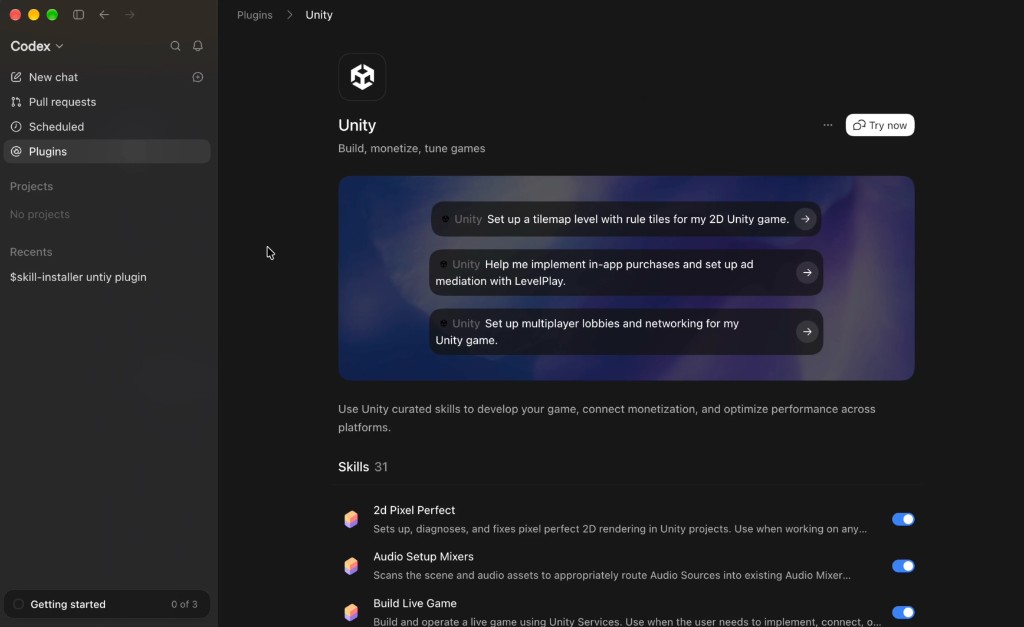
Unity’s official Codex plugin unity-agent-plugin (0.1.6-beta) ships 31 Skills. They are grouped below by use. The English name in the first column is the one to specify.
Project, editor, and packages
| Skill | When it fits |
|---|
new-unity-project | Starting a game or prototype from zero: concept, target platforms, monetization direction, then project creation, version control, and required packages. It does not generate a finished game. |
unity-cli | Driving Unity from a terminal: Editor installs, projects, modules, licenses, builds, tests. With a connected Editor, it can also inspect the hierarchy, run C#, and change scenes or assets. |
unity-package-management | Add, remove, upgrade, or query UPM packages through the Package Manager C# Client in a headless or CI environment. Avoids hand-editing manifest.json and breaking dependency resolution. |
generate-editor-search-query | Finding a specific asset or object in the current project or scene. Builds a Unity Search (Quick Search) query and opens search. Read-only: materials, Prefabs, GameObjects, components, references. |
UI, text, and localization
| Skill | When it fits |
|---|
ui | The entry point. The request is “make a menu, HUD, settings screen, button” and the UI framework is not named. Detects UI Toolkit, uGUI, or IMGUI, then hands off. |
ui-uitk | UI Toolkit on Unity 6+: UXML, USS, UIDocument, data binding, custom Visual Elements, Manipulators, PanelSettings. Fits new UI and Editor or runtime UI Toolkit projects. |
ui-ugui | Canvas uGUI: RectTransform, Layout Group, Canvas hierarchy, Prefab UI, ScrollRect. Fits existing uGUI projects, or work that is explicitly Canvas-based. |
ui-imgui | OnGUI / OnInspectorGUI IMGUI editor tools, custom Inspectors, PropertyDrawers. New editor tools should start from UI Toolkit unless existing code or the request is IMGUI. |
optimize-text-mesh-pro | TextMeshPro font fallback, fallback atlas, SDF, padding, AutoSize, world-space vs UGUI, and text-related memory or performance issues. |
localization | Unity Localization: Locale, String / Asset Tables, Addressables, CJK font coverage. Fits multilingual UI, translation flow, and missing CJK glyphs. |
2D, sprites, and Tilemap
| Skill | When it fits |
|---|
2d-pixel-perfect | Pixel Perfect Camera setup for pixel-art 2D, plus shimmer and blur diagnosis. Distinguishes URP from Built-in so the two APIs are not mixed. |
sprite-editor | Sprite Editor data providers: sprite rect, border, pivot, outline, plus automatic, grid, and isometric slicing. |
sprite-segment-3x3grid | Color-match analysis of a sprite into a 3×3 text grid. Helps judge the center color against the neighbors; can feed RuleTile rules. |
manage-sprite-atlas | SpriteAtlas V2 master / variant atlases, packing, and platform settings, including a pre-build pass that creates or configures atlases. Manages sprites that are already in the project. |
tilemap-palette-create | Create a Tile Palette for rectangular, hexagonal, or isometric grids. Fits setting up the painting surface for level art. |
tilemap-ruletile-createempty | Create an empty RuleTile, HexagonalRuleTile, or IsometricRuleTile with no sprite input, so rules can be filled in by hand. |
tilemap-ruletile-createfromsegment | Create an auto-tiling RuleTile when terrain or edge sprites already exist. Can take a 3×3 analysis and turn it into neighbor rules. |
Graphics, rendering, and visual quality
| Skill | When it fits |
|---|
migrate-birp-to-urp | Move Built-in to URP, or fix magenta materials after a move. Covers materials, shaders, 2D, PPv2, lights, lightmaps, reflection probes, and quality settings. |
urp-postprocessing | URP Volume setup and debugging for Bloom, Tonemapping, color grading, depth of field, Vignette, Motion Blur, and related effects. |
validate-urp-render-graph-renderer-feature | Review a Unity 6+ URP Render Graph ScriptableRendererFeature / Pass: resource wiring, material binds, descriptors, global resources, Render Graph conventions. |
shader-graph-create-custom-node | Turn HLSL into a custom Shader Graph node, including reflection export and function / parameter hint markup. |
optimize-web | Unity WebGL / WebGPU download size, first load, browser performance, and power use. Compression, CDN, asset stripping, shader variants, KTX, quality settings. |
Audio, physics, and navigation
| Skill | When it fits |
|---|
audio-setup-mixers | Inventory the scene and audio assets, classify Audio Sources, and route them onto existing Audio Mixer Groups. It does not silently add a Mixer or Group; it lists gaps and suggestions first. |
optimize-audio | Load Type, sample rate, codec, Mono, and Mixer layout for short SFX, music, and ambience, to cut memory and CPU. Asks for measurement and a device build. |
physics-3d-collision | Diagnose 3D PhysX collisions / Triggers that never fire, tunneling, missed raycasts, exploding ragdolls, AddForce. Scope is MonoBehaviour 3D physics. |
initialize-ai-navigation | AI Navigation: NavMesh Surface, Agent, Obstacle, Link, Modifier, Area / Cost, patrol, avoidance, carving, animation integration. |
Connectivity, services, and monetization
| Skill | When it fits |
|---|
build-live-game | Unity Services backend and live-ops: auth, Cloud Save, Cloud Code, leaderboards, achievements, progress, economy, server authority, Remote Config, experiments, analytics, deploy. |
setup-multiplayer-services | Realtime multiplayer architecture and implementation: Session, Lobby, Matchmaking, Discovery, host / client, and how that sits with Netcode. Fits rooms, teams, and realtime interaction. |
setup-vivox-voice-chat | Unity Vivox voice and text: mic permission, VAD, push-to-talk, volume / mute, speaking indicators, team chat, proximity 3D audio, messages. |
implement-in-app-purchases | Unity IAP: catalog, consumable / non-consumable / subscription, pending-confirm, receipt validation, entitlements, restore, Apple / Google extras, migrating an existing third-party payments setup. |
levelplay-unity-integration | LevelPlay Ads Mediation: Rewarded, Interstitial, Banner, ad units, init, Android Gradle / iOS CocoaPods, ATT, ILRD, and moving off older IronSource / Unity Ads setups. |
Takeaway
Unity codebases are old. These Skills are a convenient way to rewrite a project against current docs. What sits in the editor is often years of APIs, Built-in settings, and outdated UI or IAP code. Name the matching Skill, and Codex can change the open Unity 6 project the way URP, UI Toolkit, and IAP are written now.
UI requests often say only “make a settings screen or HUD.” Whether the project is UI Toolkit, uGUI, or IMGUI is not in that sentence. Writing against the wrong stack means fixing the hierarchy later. Name ui first, then ui-uitk or ui-ugui, so Codex reads the project before it builds the screen.
Rendering and post-processing have the same shape. Many projects are still on Built-in. After a move to URP, materials go magenta, PPv2 does not line up, and a custom Renderer Feature wires the wrong resources. Name migrate-birp-to-urp, urp-postprocessing, or validate-urp-render-graph-renderer-feature, and Codex can migrate and check against current URP.
Live features used to mean assembling auth, save, rooms, voice, IAP, and ad mediation from separate docs and old third-party setups. Name build-live-game, setup-multiplayer-services, implement-in-app-purchases, or levelplay-unity-integration, and Codex can wire Unity Services and current IAP / LevelPlay into the open project.